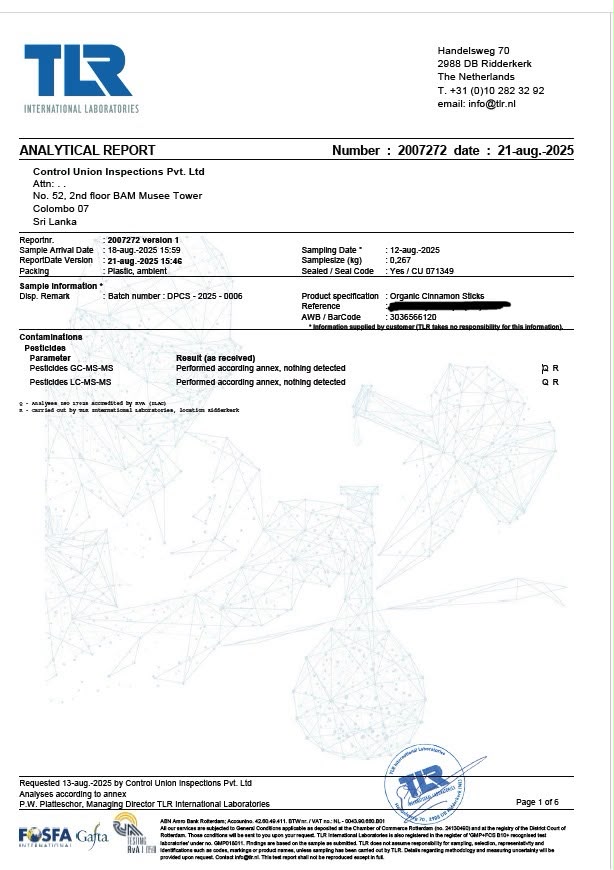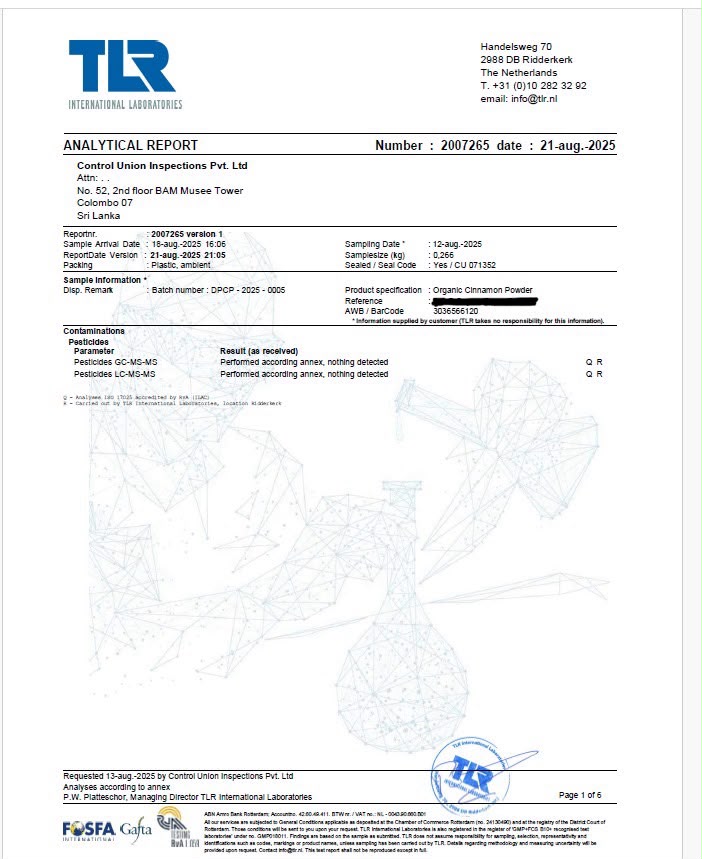
Organic Tested Ceylon Cinnamon: Pesticide Testing for the European Market

What Is Organic Tested Ceylon Cinnamon?
Ceylon cinnamon (Cinnamomum verum) is a variety of cinnamon native to Sri Lanka, widely recognized as the world’s true cinnamon. It is also known for its naturally low coumarin content compared with cassia cinnamon.
Centuries ago, spice traders came to Sri Lanka in search of this remarkable spice. Since then, Ceylon true cinnamon has reached markets across the world. Over time, the traditional spice trade has evolved into a more standardized and regulated industry, while consumer demand has increasingly shifted towards organic and health-conscious products.
As a result, organic Ceylon cinnamon has become an important product in the international spice trade.
To supply organic cinnamon, producers and exporters must comply with the relevant organic standards and hold the required certifications, such as USDA-NOP, EU Organic, JAS, Demeter, and others, depending on the target market.
However, when exporting organic Ceylon cinnamon to Europe, holding an EU Organic certification alone may not be sufficient for a particular shipment. Laboratory pesticide residue testing may also be required as part of the applicable verification process.
It is important to understand that organic certification and laboratory pesticide residue testing serve different purposes. Organic certification verifies compliance with organic production and handling standards, while laboratory testing checks for pesticide residues in the tested sample.
Read more: [Ceylon True Cinnamon – Learn More]
Read more: [Understanding Organic Certifications]
Why Is Pesticide Testing Important for European Organic Cinnamon Imports?
Pesticide residue testing plays an important role in verifying the compliance of organic Ceylon cinnamon intended for the European market. It helps assess pesticide residues against the applicable European Union Maximum Residue Levels (MRLs), established under Regulation (EC) No 396/2005.
Where no specific MRL applies, the EU’s default limit is generally 0.01 mg/kg, subject to the applicable regulatory provisions and exceptions.
Pesticide residue testing can help identify potential contamination, support regulatory compliance, and reduce the risk of shipment delays, rejection, or other import-related issues.
For organic imports into the EU, an appropriate electronic Certificate of Inspection (COI) is required. Laboratory reports may be requested by the relevant control body as part of its verification process before the COI is issued.
Key Reasons for Pesticide Residue Testing
- Compliance with EU regulations: Helps assess pesticide residues against applicable legal limits.
- Verification of residue levels: Helps identify residues that may exceed the applicable MRLs.
- Contamination risks: Helps assess potential risks from pesticide drift, cross-contamination, and other sources.
- Preventing shipment rejection: Helps reduce the risk of regulatory problems during import.
- Regulatory scrutiny and traceability: Supports verification of product history and compliance.
- Certificate of Analysis (COA) requirements: Provides documented analytical results when required by buyers or relevant control bodies.
Two important analytical methods used in pesticide residue testing are Pesticides GC-MS/MS and Pesticides LC-MS/MS.
What Is Pesticides GC-MS/MS Testing?
GC-MS/MS stands for Gas Chromatography–Tandem Mass Spectrometry.
This analytical technique separates and identifies pesticide residues suitable for gas chromatography, including many relatively volatile and thermally stable compounds.
It enables laboratories to detect and measure targeted pesticide residues in Ceylon cinnamon samples. The specific pesticides covered depend on the laboratory’s analytical method and testing scope.
What Is Pesticides LC-MS/MS Testing?
LC-MS/MS stands for Liquid Chromatography–Tandem Mass Spectrometry.
This technique is suitable for analysing many pesticide compounds that are less suitable for gas chromatography, including various polar and less volatile compounds.
When used alongside GC-MS/MS, LC-MS/MS can help laboratories cover a broader range of pesticide residues in Ceylon cinnamon samples.
Together, these two analytical methods play an important role in assessing pesticide residues and supporting the verification process for organic cinnamon intended for the European market.
What Happens After the Laboratory Test?
After the Ceylon cinnamon samples have been analysed, the laboratory issues a report indicating whether pesticide residues were detected and, where applicable, their measured concentrations relative to the method’s reporting limits.
If no targeted residues are detected above the method’s reporting limits, the report may state that they were not detected. If residues are detected, their measured levels must be assessed against the applicable MRLs and other relevant requirements.
A satisfactory laboratory report can support the organic verification process. However, the final assessment and issuance of the COI depend on the applicable regulatory requirements and the decisions of the relevant control body.
Source Organic Tested Ceylon Cinnamon from Sri Lanka
Sourcing organic tested Ceylon cinnamon for the European market requires more than an organic certificate. Proper traceability, appropriate laboratory testing, and valid organic certification all play important roles in supporting product quality and compliance with applicable requirements.
At Uzesty Naturals (Pvt) Ltd, we are committed to supplying Sri Lankan organic Ceylon cinnamon to international B2B buyers, with a focus on quality, transparency, and reliable documentation.
If you are looking for an organic Ceylon cinnamon supplier in Sri Lanka, contact Uzesty Naturals to discuss your product requirements and request available product specifications and certification documents.